Monday, 3 September 2012

Peru Stories Week 5


July 8th, 2012 (Friday)
We took the overnight bus from Trujillo to Huamachuco, Peru.

July 9th, 2012 (Saturday)
Arriving in the cold dark morning of 3am, we hired the local transport of Toyota Hilux to get us to the gold mine near Chuquitambo, our destination.

Just to recap, the purpose of our trip is to install concrete foundations at the village, for a future wind turbine. We brought welded re-bar cages for the foundation from the WindAid workshop in Trujillo.

Each valley on the way to Chuquitambo is sort of a micro environment. The first one we drove through (had paved roads!) had a nice town and a big lake.
Then there's the plateau that looked like Scotland, where there was a small rest stop where we had soup for breakfast, in this valley the road is still nice gravel. Fluffy grazing sheep dotted the rolling green hills. There are also ponds and rocky outcrops.
The next valley had a large river on the bottom, with mountainsides covered with fairly respectable vegetation. We crossed the river on wheels as it is the dry season.


The final valley where our village is located in is extremely hot, with a deserted landscape and cacti covering the bottom, where sharp cliffs dropped into the raging river. Before reaching the gold mine, small villages adorned the side of the road, some are only a few houses while others have their own central plaza and school. Chuquitambo is on the far side of the valley and it took us about 5 hours of driving to get there from first entering the valley from the top.


Of course, with all this driving we actually have to climb winding roads to top of the valley, then descend to the bottom and ascend over the ridge again. Most of the roads are bumpy gravel and at places wooden planks bridged gaping chasms. Including volunteers, there are 6 people from WindAid, a driver, and another local passenger. At first, we experimented with squeezing 7 people in the cab, with one person sitting on the CD box. Finally we ended with 6 in the cab and 2 in the back of the truck along with all the luggage.

The road is wide at places, just enough for 2 vehicles to pass, and narrower at others. If 2 vehicles came head to head, one of them must back up to a wider stretch. I saw 2 trucks behind us try to pass one another and some pebbles slid down the cliff because one of the wheels was so close to the edge. The roadside do occasionally have grave markers. At one point, there were more than 8 wooden crosses. The driver told us it was a bus driver who went out to relieve himself and left the bus in neutral.

We crossed a bridge over the river at bottom of the valley, and ate rice and fried chicken at a local restaurant. There we switched to fully kitted trucks from the gold mine - they had air conditioning, roll cage, lights and fire extinguisher, and picked up our cement. Of course the best part is having proper space to sit.
Driving up the mountain we passed security checkpoints for the gold mine, one of which featured a guy with an AK47 rifle.


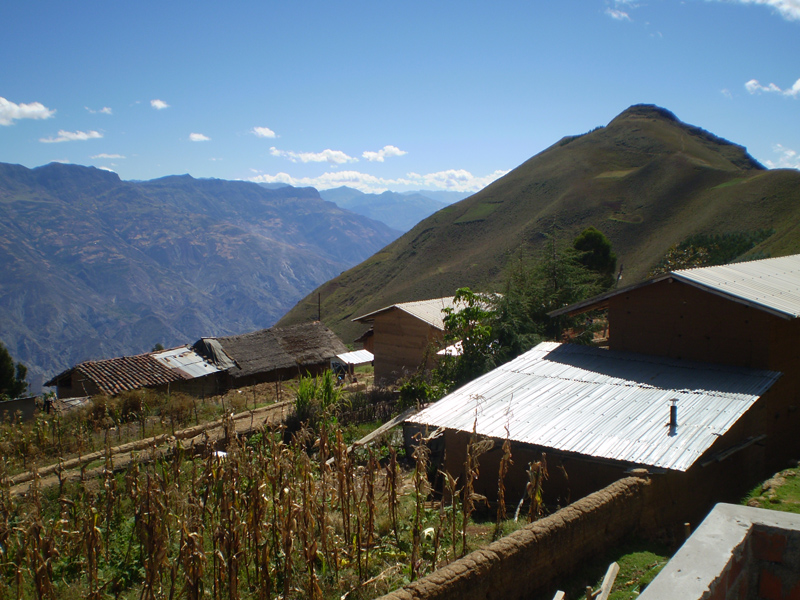
Finally we arrived in Chuquitambo, which was a very nice village with a brand new school. The main road is above the village and we drove down to a grassy lot to unload our gear. Over 200 people live in the village and most of the houses are made out of adobe, a fairly solid dried mud - straw mixture compacted through sheer will and labour. The activities here involve raising chicken, lamb, donkeys mostly, and occasionally horses and oxen. Eucalyptus trees are planted on the slopes to prevent erosion.

Our host was Abraham. He is a carpenter, and owns the only grocery store in town.

We were treated to a nice warm dinner before sleeping as the sun went down at 6pm. The temperature plummeted from almost 30C during the day to merely 3C at night. At this village, there is running water coming from the mountain springs, but it is cold. Abraham's house has a shower which we never used (because of cold) and a working toilet (which is a rarity in the region). At night, we use thick blankets to keep warm. There is a diesel generator for the village, and existing grid. However the generator has some problems and use expensive fuel, so most of the time people sleep early, and use flashlights and candles.


At night, the stars can be seen in their full glory.

July 10th, 2012 (Sunday)
The day started with breakfast at around 9, also a formidable meal. Then going and looking at the village generator, which has some vibration problems. There was an older generator which broke, probably from another problem, but end result being the piston smashing through the engine housing, which is not a normal failure mode. After that we went to a village meeting, held at their school. The WindAid employee, Fernando, also a mechanical engineer, explained some stuff about the turbine. Other topics of the meeting include raising funds for buying books and stationary for the school and how much people owe the teacher, as well as whether or not people that doesn't have a kid in the school should pay their contribution to the community education fund.

After this was lunch, then we headed back up to the school where we selected a spot for the turbine to dig our first hole. It was about a cubic meter and took us all afternoon as we're unused to the labour and altitude.


 The day ended with us watching a game of soccer at the field behind the school. An awesome amount of earth must have been removed to make the field and we never found out what did it, but most likely machinery was brought in from industry. During part of the game, a horse ran onto the field and had to be led away.


July 11th, 2012 (Monday)
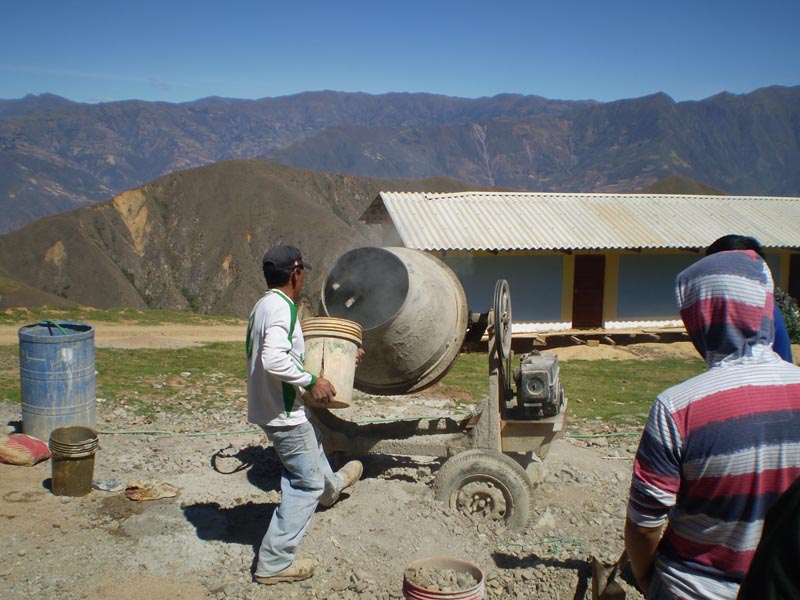
On this day the villagers and volunteers dug the other 4 holes for the turbine foundation, and poured concrete all before lunch. Of course the villagers worked efficiently and we just stood by and watched. At first there was some disagreement about the mixture of concrete - the locals thought there should be way more gravel in the mixture than we did. As the bags of cement were giant and holes doesn't seem so big, we thought they wanted to save some extra cement out of this. However it turns out us mechanical engineers have no idea what we were talking about (Fernando didn't pay attention to this detail during previous turbine works), and had to actually find random rocks to throw into the foundation to make up the volume.


After the works, we all joked about leaving signatures in the wet concrete. Finally one of the volunteers caved and left the impression of his naked butt in concrete.


After lunch, we hiked up to an ancient Incan lookout. Some of the mountain slopes do not have clear paths, and since my boots didn't fit perfectly walking up the incline and climbing some of the rocks were awkward. The view up top was great, and I brought a water bottle and my sketch book by clipping them to my belt with carabiners. We made our way back "home" at about the same time the sun is setting and the sheep are going home, it was a beautiful scene.


July 12th, 2012 (Tuesday)
We arranged for transportation to get back to Trujillo after our work is done, however the arrangement depended on availability of vehicle so we had to stay one more day. Which means one more day of not showering, but one more day of amazing hospitality and exploring the locale.
We started the day with visiting the secondary and primary schools again, saying hi to everyone and taking group photos. The kids here are much shyer than those at Playa Blanca. As it is in less industrial lifestyles, most of the secondary school students are also parents. 


In the privileged world, we balk at the idea that "children" should be warriors or parents. But childhood today is an invented concept made possible by the dominance of machine. When the earliest humanity carved out their living against the forces of nature, those in mid-teens would be respected as adults, and in their thirties old and wise grandparents. The way people live their lives are intimately linked to the condition they live in.

For this day's exploration we took the shepard's path to try and walk along the ridge top behind Chuquitambo. The shepard's path is definitely difficult, sometimes we wonder if we were on the sheep's path - having 4 legs is an advantage climbing. However there are some thorny plants and I did not dare go on all fours. Before getting to the top, we tried this path that had collapsed and had to turn back. While on this path, a startled bird squaked and shot out into the canyon from some bushes. Everyone almost lost their balance, and my friend said the bird hit him in the head.

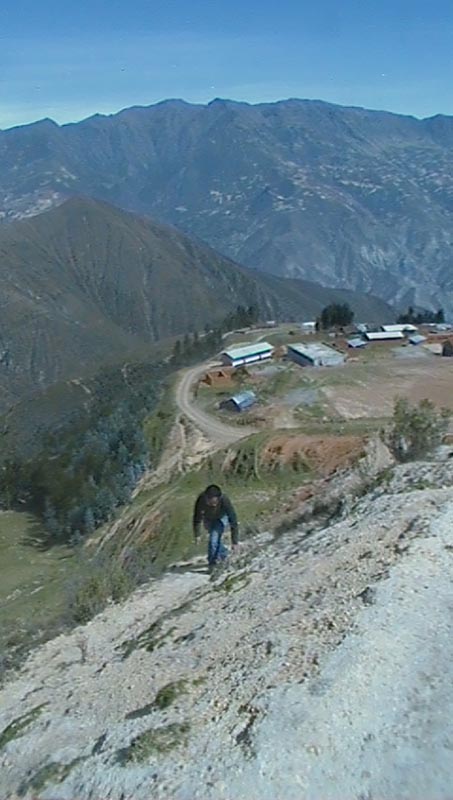


We walked along the ridge, which was fairly wide and flat, a leisure stroll. It was a half-day walk and we descended along a dried stream bed. Made our way back to the village along the main road.
I also got to have some time to show some kids how to draw. At night we played an evil game of Parcheesi. The rules were so cryptic that the volunteers argued at length about the interpretation. Finally Fernando said, "I don't understand" due to our heated debate in English, to which we replied, "It's okay, neither do we."


July 13th, 2012 (Wednesday)
This day we said goodbye to our friends in Chuquitambo and started on the long journey back to Trujillo. This time we had a large passenger van that could seat up to 14, which was comfy and roomy compared to the pick-up ride. At one point we had to pass a crazy bus driver by backing into the corner of a cliff. I told my friend who was freaking out to "scream in a high pitch if you see that rock beside our wheel fall into the cliff" which he did not take amusement of.

July 14th, 2012 (Thursday)
After arriving in Trujillo at about 4 in the morning I showered and slept, while all the others did the reverse order. We met an old volunteer who took some time away to see South America and played soccer in the afternoon.

July 15, 2012 (Friday)
On this day we packed, exchanged photos and data, and bid farewell to everyone. My friend and I took the La Linea overnight bus from Trujillo to Lima, which had luxurious fully reclining seats and individual entertainment screens.

July 16th - 17
On the 16th, we arrived early in the morning and made our way to Miraflores district, after depositing our bags at Hotel Kanama which we stayed at a month ago. We walked around for the stores to open and shopped around for souvenirs and gifts. We retrieved our bags and took a taxi to the airport at night and after another long journey arrived in Toronto at 1pm on the 17th.

Wednesday, 22 August 2012

Peru Stories Week 3-4


May 25th, 2012 (Friday, Weekend)
Over the weekend we stayed and chilled at the volunteer house, which happened to be Michael's house, in the city of Trujillo.  There are 2 rooms with 6 bunk bed spaces. The house staff cooked great, healthy meals for us.
While most of Peru eat fried chicken (due to food safety reasons) and rice, with very little veggies,  one could order a 2L jar of freshly squeezed juice almost wherever you go. (Of course since juice is made with ice so that's not exactly "safe" either, but a lot more delicious than salad!)
Back on topic, lunch is the main meal in Peru and the volunteer house staff prepares for us great big lunches on weekdays. Dinner consist of soup and bread. The local spicy sauces are quite exotic and I've tasted a few different kinds.


Trujillo itself is a sprawling and flat city, with colonial atmosphere and very few high-rise buildings. The climate is perpetually 20 degrees and never rains. Crime is actually something one have to watch out for in this city and foreigners should go out in groups. There a zoo different of taxi and bus services in Trujillo, the yellow taxis are not safe, but "New Taxi" is reputable (in fact, the drivers pay a premium and the company punish drivers for breaching their strict regulation, to maintain their standard of conduct). Michael's house in Trujillo is located in a safe and relatively uppity neighbourhood, with supermarkets and malls about 20min walk away.

On the weekend the volunteers went to the supermarket to get food and my friend, who really enjoys cooking, organized a volunteer cook-together and made a meal. But other than this, we volunteers were, unfortunately, rather lazy and couch-potatoed most of the weekend. Instead of watching TV, I doodled in my sketchbook, and caught up on world news. But not being fluent in Spanish, I didn’t want to go outside by myself.

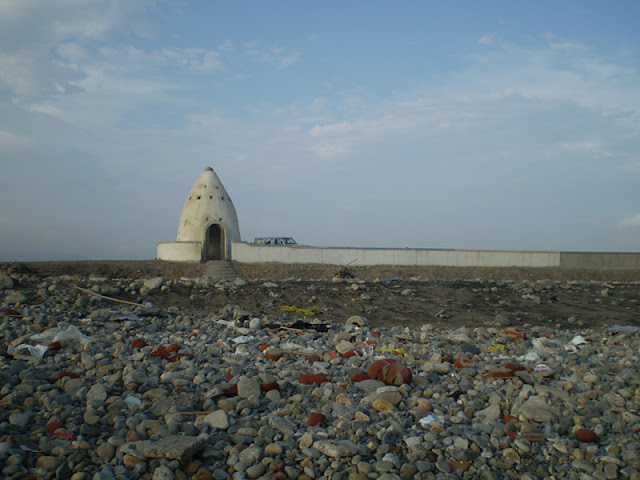
Also during the weekend Michael took us to see Buenos Aires. This used to be a nice-ish beach until someone near the delta decided to change how the river enters the sea, as part of a project. The result is that sand on the beach is no longer replenished. Most of the beach is gone, in fact, 40m or so of sandy beach was supposed to have disappeared over 4 or so years, replaced by a rocky field filled with junk of the Pacific. We then went to see the meteorological station that Michael built, also near the sea. It was a small egg-shaped building was to house equipment for testing of WindAid's wind turbines. Due to beach erosion ocean spray gets closer to the egg building and the salty mist over time has eaten through even concrete - this is no place for electronics.

This weekend another long term volunteer arrived to join us, coming from Scotland, making it 5 volunteers altogether. Apparently for unknown reasons there has been many Scottish volunteers before.


May 28th, 2012 (Monday)
First day at the workshop!
The workshop is about 20min away by car, and of course we had to stop on the way there for the Inca Kola and cigarettes for our boss.

The WindAid workshop is a warehouse space about 30x30m with sections near edge of the room divided off for different tasks, and center of the building used for general work and assembly. There's an electronics area, resin casting area, welding area and painting area. There's various scrap metal and machines like CNC mill and plasma cutter.

On the first day we did not get to the workshop by 11am since Michael had to work on some calculations for the plan to electrify the community of Playa Blanca. We end up familiarizing ourselves with the workshop by taking turns learning to weld, and coiling wires for the generator. We left the workshop at 2pm to go home for lunch, and one of the volunteers asked Michel "are we going back after lunch?" to which he replied, "no, normally this is it."
At first I did not believe that I heard or understood it right, but as no one is driving the truck after lunch the volunteers settled into their normal spots on the couch and watched TV all afternoon… (*facepalm)

May 29th, 2012 (Tuesday)
This was the day we learned how to cast turbine blades. The blade is made of steel rod core, surrounded by a cast foam core. We had to carefully wrap the core foam in carbon fibre and then glass fibre. Then place the whole thing in a mould and clamp the mould shut, using 20 or more C-clamps.
The mould is unfortunately made of the same material as the final resin, so the mould must be generously waxed to prevent the blade from bonding with the mould. We hot-glued the mould and checked for air leakages, then hooked up the casting pipes and poured mixed resin into the mould.
The mould is hung like a slab of meat or wounded animal on a hook. It was truly a horror-story scene. Negative pressure draws resin into the mould and it is all left overnight to solidify.


May 30th, 2012 (Wednesday)
This day we played soccer with taxi drivers in the mini-soccer field in the mall, in the morning, before going to work. I chatted with Michael about his career and his stories. Michael grew up in Indianapolis and worked on an Airforce base after highschool. He did databases and websites for a few years after that, then started an import business. Michael also had an interest and got training in rally racing. After re-evaluating living in the States, he moved to Peru in hopes of doing some societal good and the rest is history. (Sorry for butchering this, Michael. As you can see, I'm a very dispassionate writer.)

May 31st, 2012 (Thursday)
This day we left work early and Michael drove us to the temple of Sun and Moon. These are built by the Moche people, and the names of the temple are invented by archaeologists, rather than the original names. [http://en.wikipedia.org/wiki/Moche ]
These temples took the form of raised hills (pyramid-like) with some structures on top, of course there are no internal rooms inside the pyramid save for buried objects or older versions.

The "Sun" temple was the administrative region, it is not open to the public. The "Moon" temple was used for religious purposes. Warriors fought to the death and their blood was used to soak the ground. The losers may have been skinned or ripped apart dead or alive. For all the graphic violence, this was a religious ritual and the areas where all the violence takes place are not accessible to the public. However, the "king" would have held the head of the sacrifice for the crowd awaiting outside to see, so they would have proof that the rituals are indeed done. The Moche worshipped Decapitator God, and decorated the temple with various forms of his face. The outside is decorated similarly, although tied slaves, dancing jesters and animals can also be seen.  The 1700 year old paint job is colorful and vivid due to being buried in the ground.

All corporations in Peru need to somehow satisfy a "public good" requirement. Most do very little to get by. However, the Moche archaeological park is looked after by the local beer company, who took excellent care of administration due to the strategy of long term commitment.

We took one of the microbuses back to Trujillo. It was a tight squeeze with 15+ people in what I call a "hippy van" that must've originally had seats for no more than 8.


June 1st, 2012 (Friday)
Judging from the photos, we might have actually worked until dark (all 8 hours) this day!

June 2nd, 2012 (Saturday)
This afternoon we went to the beach town of Huanchaco, another nice beach/surfing place. However this beach suffers the same beach erosion problems, although not as crippling as Buenos Aires. I sketched and explored the area while other volunteers played in the water and played beach ball. I found a nice stuffed fish museum which also had model ships. Locals at the beach asked where I'm from, and whether I have the world-famous Canadian product of "weed" which I did not.

We watched the beautiful sunset, had dinner, then martinis at a reputable beachfront place. We left at about midnight and wandered back and forth along the beach in hopes of catching one of the more reputable taxis. It was high-tide and the waves washing over rocks made a demonic skull-cracking noise. (We then debated passionately about the logic of that claim, with no one actually having ever cracked a skull - I hope!)
Eventually we caught a "New Taxi" heading back to Trujillo after 1am! Despite notoriety of South American nightlife, the peaceful beach town does not stay up late, and this must've been the last car to be out and about. The driver was as happy to see us as we were him.


June 3rd, 2012 (Sunday)
Not much. Couch potato-ing. Might have had soccer, my friend organized another cook-together and watched movie after. We may have reviewed the Batman franchise in preparation for Dark Knight Rises.

June 4th, 2012 (Week of)
Most of this week Michael was not here. Mr. Able drove us to the work shop in his yellow taxi! (The yellow taxis are the least reputable taxi line in Trujillo and Michael warned us not to get in one on the risk of armed robbery).

This week we worked mostly full 8 hour days, due to last week's boredom of couch-potatoing. On Monday we cleaned up the whole workshop, whereas Michael went to Playa Blanca again, trying to bring them a (better) working inverter.

On subsequent days we helped with WindAid's experiment of a smaller, 2-bladed turbine. This turbine would be produced more easily and in greater amounts. In fact, the concept calls for a parent mould to produce copy moulds, which can be given to local groups to cast their own turbine blades. However everything is in experimental stage, and mould-making is hard due to the amount of resin and fibres needed, which all must be laid out in neat layers. Due to this work and our various long road-trips we could not finish one of the large turbines. (We did wind the number of copper coils, and cast all 3 blades, so despite all the procrastination it was still significant.)

I believe during this week we had another WindAid vs. Taxi Drivers soccer game. I also went to a nightclub for the first time ever. Unfortunately that night there were not many girls, I did not dance and we left after a short while.

This week we teetered on the plans of our final roadtrip. The original plan was to go to Cajamarca, where we do maintenance on a turbine for an unspecified problem, then bring it back up top. The Cajamarca community is very rustic and we would experience interesting living conditions. Also the final 1h or so leg of the journey would have to be made on horseback! (The horses would have to carry the turbine as well!)

Because the community never sent us the turbine for maintenance, and also the region was blockaded due to strike / civil unrest, we switched to the secondary plan of going to the Pataz region. The job for this trip would be to install concrete foundations at the community of Chuquitambo, so that a future turbine can be installed there. Although it's an easy job the main warrant for all the volunteers going is so that we can learn more about the people of Peru and tell our friends in the developed world what we've seen here.

For the whole week before Friday morning, the plan changed just about once every two hours: We may or may not go to Cajamarca, then it's we may be leaving any time between Saturday and Sunday, accompanied by one or another WindAid permanent employee, either taking Michael's truck or bus, or maybe on the back of a government lorry, having accommodation at a hotel in Pataz or in the village when we arrive.

During this time, Michael got in a bus to brave the blockade of Cajamarca to have a business meeting there.


June 8th, 2012 (Friday)
Finally, on Friday morning, we got the final word: despite what is said the night before, we leave on Friday evening on a bus. We were given the day to do whatever we want and see as much of the city as possible. After packing all our stuff, my friend and I decided to go to Chan Chan, the famous UNESCO site while other volunteers sat on the couch and watched TV.

Taking the bus to Chan Chan, an ancient city left by the civilization that was here after the bloodthirsty Moche but before the Incans, we walked through the desert from the bus station to the actual site. An old man gave us a guided tour, then asked if we would like to see Temple of the Rainbow.


We got in a taxi with the guide, although the taxi fare was supposed to be negotiated before we get in, we thought the guide and driver had some agreement. When we got out and was told that the fare was 20 soles, we realized their agreement was in scamming us. Then our guide showed us the site which was tiny seemingly seldom-visited, and charged us another 20 soles for the tour. (A normal taxi ride across the city would be about 6 soles. Truly, he charged us a Gringo's Ransom!) Of course we ended the mis-adventure by taking a dreaded yellow taxi home, because no other reputable taxis can be seen in the shady neighbourhood we found ourselves in.

At night, we had a small birthday party for our Scottish volunteer, then got to the bus station to be on our way to Chuquitambo.

Wednesday, 8 August 2012

Peru Stories Week 2


Week 2

Day 1 / May 21st, 2012
The boss of the WindAid, Michael VerKamp, asked me and my friend if we want to join him on a road-trip as soon as we get off the plane in Trujillo, as "something came up". I decided to go so we were picked up as soon as we get off the airport for a 6 hour drive. The airline, TACA, had great service as they provided food for even one-hour hop flights, however they never know which terminal the plane will come in at so kept changing the terminal. On the flight over the Andes we could clearly see mountains and how the color and coverage of vegetation varied from one valley to the next. Clouds filled some valleys but not others demonstrated the partitioning effect of mountains.

We arrived at the airport in Trujillo after transferring in Lima. The airport is so small it has only one terminal. The car that Michael drove to pick us up is similar to a Nissan Pathfinder. It used to belong to the security of the French Embassy and has a siren. Michael is funny and has tons of stories to tell. He also seems to run on cigarettes and Inca Kola [http://en.wikipedia.org/wiki/Inca_Kola]. We crammed into the truck with fellow volunteers Paul and Nick.

It's a 6-hour drive from Trujillo to Sechura along the Panamericana Norte highway. The drive through the desert was an experience, just how endless the dunes and sand stretch out on either side. It's so peaceful that it would be a perfect place for meditation. No wonder sometimes in imagery the desert and sand is associated with time and eternity. Of course appearances are deceiving, when we're driving at [broken speedometer] speeds, the landscape do change rather quickly. The desert are also dotted with dried-up living trees. These short trees are supposedly able to survive in a dormant state without water for many months, and revive to grow spread seed given the occasional rain. Their barbs also has a chance to penetrate a car's tire, or soles of heavy-duty work boots.
I must also mention the traffic, during the drive we constantly dodged between our lane and the incoming traffic to pass slow-moving vehicles. Of course sometimes the other side tries to do the same and we'd have to dodge onto the curb. The traffic rules in Peru is quite simple, the biggest vehicle makes the rules. (Similar to Golden Rule:"One with the gold makes the rules.")
The side of the road are dotted with occasional settlements. Sometimes a town and on many occasion chicken farms, since chicken is a staple food in Peru. The road ran parallel with power transmission lines, and cellphone towers rose on the top of hills. However the people living along the road do not get any of the power since there are no transforming stations or local distribution. However they try to use poles to steal the power. (I don't actually know how this works.) While others either run their own generators or tried building wooden windmills to generate power. Michael hope to sell a new, smaller wind turbine under development to these people which can increase his publicity as so many drive along the highway, so that he may get more funding from the government.


At night we stopped at a roadstop for you guessed it, cigarettes and Inca Kola, and appreciate the starlight. The scene was also unreal, it was like a scene from Twilight Zone: dark for miles around, with the only light coming from headlights of our car and windows of the grocery store.

We bribed the highway police to get through a roadblock. It's blocking a stretch of the highway "under repairs" due to heavy rains brought by El Nino and climate change: there's a lake in middle of the desert and some of the road is washed out. Michael used to get stopped by the police about every hour on these trips, until he put green reflective tape on the bumpers like the police do. Usually the 10 or 20 soles would be good to make the police let you go. Michael once argued with the police for not having done anything wrong, and after showing all the right paper work the police said, "Hey, you didn't have your safety triangle. That's not safe and against the regulations." And he was fined over 100 soles. Anyhow, it would've been a 4-hour detour if we didn't bribe the police to go through the roadblock, so there's no choice in the matter. Of course, the police were very nice, just very underpaid.


When we got to Sechura, the local drivers paraded us around the town after we asked them for directions. (We drove behind them and they drove in circles.)
We stayed in a shady hotel in Sechura, where there isn't any hot water, and bathroom was quite dirty. At night the volunteers had beer out in front of the hotel and we gave one to the hotel owner. Later we found out we gave beer to a man carrying a gun who hasn't slept in 3 days. Of course, Sechura is a very safe and relatively crime-free town, in stark contrast to Bayovar which I will talk about later.

Day2 / May 22nd, 2012
This morning we woke quite late due to all the traveling, and rode a mototaxi (a sawn-in half motorcycle with a passenger cage attached to the back) to center of town for brunch. While there's only seat for 2 me and Nick stood on the back of the cab and waved at everyone as if we're riding a Roman chariot.


Later we went to SeaCorp's barracks to show Michael's prospective clients the wind turbine installed there. SeaCorp is a scallop farming business run by Michael's friend, Ian. Scallop farming was the main local economy. There was actually a black tide in February that killed all the scallops in the bay, and some scallop farm business owners killed themselves because of the disaster. SeaCorp is the biggest of these businesses and they are trying to restart with bringing in more technology to add redundancy.


[Previous operators of this car at the French Embassy were trained in gun'in and run'in]

After SeaCorp we went for a business meeting in another town. I never got the name of this town but it was mainly concerned with shipbuilding. The ships were built out of wood, about 10m long with a cabin on top, mainly used for fishing and operation of sea farms. There were hundreds and hundreds of ships lined in various stages of construction. The people there looked to be impoverished and there were camps under the shade of some of the ships. We were supposed to meet some people at a hotel but everyone we asked seemed incredulous at the idea that there could be a hotel in their town. Finally we found the hotel in a neighborhood that seemed to have been under construction for a long time, and retrieved electronics for one of the wind turbines from a trailer. While there we saw someone biking around selling melted ice cream in an ice box, and a brick house half-built around a very nice door they might have found somewhere.


Finally, at night we went to drink and tell stories at a convenience store. This night we moved to a nicer (2-star) hotel that had hot water and was clean.

Day3 / May 23rd, 2012
In the morning we retrieved a wind turbine. This one was sold to an oil and gas exploration site, and after not finding anything and leaving the area, they decided to donate the turbine to a nearby community. (Actually the original owner unfortunately passed away due to an accident.) We went there to move the turbine, and the meeting yesterday was to retrieve the electronics for the turbine.


The turbine sits on a mast 9m high, using 8 guide wires to hold it in place vertically, 2 in each orthogonal direction. There are 3 blades 6 ft long, and produces 2kW of power.
Five concrete foundations about 1x1x1m reinforced with rebar hold the guide wire anchors and the base of the mast. Cable, a short pole, and the car is used to lower and raise the mast.
The electronics consist of car batteries (easily replaceable), rectifier, inverter, breaker, and dissipator for when too much heat is generated.
The turbine has no gear box and the hub/rotor assembly IS the generator. The blades are selected to work at extremely high speeds. At optimal wind conditions, the turbine turns at a ferocious rate. The rotor-blade assembly must be finely balanced to minimize vibrations. At SeaCorp, where a contractor installed the foundations improperly, cracks can be seen inside the concrete.


We disassembled the turbine to take it to the seaside community, Playa Blanca. It's a 15km drive and we had to ride on the outside of the car because the back was stuffed with turbine parts. Of course we drove very slowly and it was safe, but we also got splashed by spray coming out of the back of a fish refrigeration truck.

The community was very nice, the turbine is put up outside of the school so kids crowded around to play with the volunteers. The foundations were pre-installed so we only have to reassemble the pieces. 


[Playa Blanca is a community of less than 200 people]


We went for lunch at the nearby port of Bayovar, where they're supposed to have fresh seafood, Ceviche - raw fish marinated in lime juice, with lots of hot sauce. We saw catches of 2m long squid on the docks. The port is said to be so dangerous that the first time Michael went there for dinner, the waitress told him to "drive out as fast as you can and don't stop even if there's a person on the road." There's also no police in the town as it is too dangerous for them to go there, and at night brawls would fill the street as if it is a frontier town in the wild west. It is rumored that criminals including murderers come here to hide from the police. Of course we finished our food and left when it's still bright and early and thus were never in danger, but also unable to verify these claims.


Back at Playa Blanca, we finished assembling the turbine and electronics. It turns out that one of the LED lights have a short which burnt out the inverter. Unfortunately we did not have a good replacement but a small inverter kept the few LEDs on. The turbine is meant to provide light for the school and eventually the town (rather than running any appliances). In the near future, as the turbine provide savings for lighting compared to candles and kerosene lamps, the community can buy more cable to hook up lights to the turbine.

Day4 / May 24th, 2012
On this day we drive back to the city of Trujillo. But first we visited SeaCorp's new facilities. There's a walled and fenced off area filled with giant modern-looking plastic containers, building material, and a shiny new generator. Ian, the owner, told us his plans and stories.

First, the scallops should be grown in incubated in the incubator facility, and another nursery facility will be built in the future so that scallops can grow to a certain size before being moved to the concessions in the sea. The incubator facility will have various chambers for growing algae and other foodstuff, seawater will need to be pumped in in massive quantities, and all filtered and zapped with over 100 UV lamps as some of the bacteria in the sea can compromise the entire system. If the system is compromised by a certain type of bacteria, the entire system must be destroyed and rebuilt. A generator will provide power for the main systems and 2 wind turbines will provide lighting and other stuff.

If building all that in the middle of nowhere, Peru, far from technological industry, sounds hard, they must contend with unique local problems as well. The generator was delivered with exhaust facing the wall and no one bothered to turn it around for quite a while. The men putting up the roof did not start assembling for 3 days from not being able to find a tool (to their credit, they finished it in a day after finding it). Excuses for coming late to work include not having had breakfast, lunch, or not being able to catch a ride.

Other stories from Ian involve him hiring shady people. Once his truck was stopped by robbers, and in response he asked which of them want a fixed salary. One man who was nicknamed "The Bear" climbed on top the the truck and lifted with his bare hands the high voltage wire that was blocking the truck. After working for a year or so The Bear was taken away by the police for murders committed before all this. There were also stories of desperate people coming to work as divers, as divers are paid alot and no police would go looking for them on the bottom of the sea. Most of the divers could not swim and simply use lead weights to walk along the bottom. A compressor and plastic tubing pump air down to the divers, and the divers communicate with their support by pulling so many times on a line. Of course some of the support staff can't count so sometimes the signal gets mixed.

We visited the community of Playa Blanca after that and the volunteers played on the beach, along with the kids. I sat in the shade and sketched a bit, also chatting with Michael about his past. Finally we left after Nick was stung after stepping on what we believe to be a stingray. The main work people at Playa Blanca do seem to be the maintenance of scallop farms. Concrete foundations are cast on the beach to be towed out to sea as anchor for nets.


On the way back to Trujillo we stopped at an upscale restaurant so Nick can have his revenge in the form of stingray pancake. The night driving was harrowing as there are no street lights and the edge and center of the road are barely visible. Most of the incoming traffic drives on high beam making it even harder to see. We narrowly missed some motorcycles driving with broken lights.