[Edit: Please excuse the poor format, I never expected this blog to be text-heavy. I'm looking into fixing this]
I was in Peru for 5 weeks, the first week me and my friend did traveling on our own, and the next 4 weeks volunteering with WindAid [http://www.windaid.org/].
Week 1 / May13, 2012
On day zero, we arrived in Lima, Peru at midnight after spending a whole day on planes and in airports.

Week 1 / May13, 2012
On day zero, we arrived in Lima, Peru at midnight after spending a whole day on planes and in airports.


Day 1 / May14, 2012
We spent the day walking around the historic downtown district of Lima, touring some cathedrals and public squares. In about every city in Peru, sometimes in even very poor towns with just one street, there's always a nice public square called Plaza De Armas or De Mayor, usually with a church or cathedral (Cathedral of Lima) facing the square. At San Francisco Monastery, there's a magical-looking library that's lit by a shaft of sunlight from the skylight, a choir room, and catacomb full of skulls. Our guide told us, "see, the niches in the well where there are skulls, those skulls don't mean anything, the archaeologists put them there for decoration when they're working." <--- so terrible. In the evening, we saw the city transform from a normal, quiet place into a really busy place, with cars and buses honking at each other constantly on the road. While during the day there are few cars, in less than 15 minutes in the evening the streets are filled. Then at 21:30 everything changed again, everyone disappeared off the streets, and near the city center only armed guards can be seen, so it was scary and we went back to our hotel.


Day 2 / May15, 2012
We spent the day walking down the Green Coast of Lima, which is a cliff side adorned with a long strip of parks. One could walk down the cliff but the beach is not really nice. The waves are strong and water cold. This is one time to see the "real ocean". When I was in Vancouver the water outside is actually blocked by Vancouver Island, I don't count that as "real ocean", same with in Shanghai. Although I have seen the "real ocean" before, it's good to see it again in Peru. There were really not a lot to see in Miraflores district of Lima, a lot of rich people and tourists live there, full of fast-food burger and coffee joints, but there isn't much historic or cultural stuff.


Day 3 / May16, 2012
We visited two ancient pyramid ruins. Pyramids are basically artificial hills used to create a raised platform. One was made by a pre-Incan civilization using vertical mud bricks. The bricks have gap in between so when there's an earthquake the bricks can move and dissipate mechanical energy. Ramps go up to top platform, where mummified burials took place. These mummies are curled up and bundled in rope rather than laid flat in sarcophagus like in ancient Egypt. These people apparently sacrificed humans, animals and artifacts (smashing up a nice vase as offering to the gods). It make sense that primitive cultures around the world all practiced sacrifice, as in their attempt to control nature, people believed giving up something of great value will allow them to receive value in return. We ended the day of tour early as we spent the last 2.5 days walking, and did not rest much after flying.

Day 4 / May17, 2012
got to Cruz Del Sur bus terminal for the long distance bus to Cusco. This is a 22+ hour drive. We drove through the favela of the city on our way out of Lima. The road up the mountains was winding and it was hard to sleep on the bus. This is one of the "safe" bus lines recommended to us, as it is said to pay "protection fees". Highway robbery do reported happen in Peru, so we were told.


Day 5 / May18, 2012
Arrived in Cusco late in the day and was met by a representative from Peru For Less, company with which we booked 3 day tour with. They arranged all our transportation to from hotel, bus station, airport, attractions. This is convenient and safer than taking taxis which have mixed reputation. We spent the afternoon in Cusco walking around on our own, exploring the historic district and museums. The altitude (3400m) does not significantly affect us when walking on level surface, but makes one tired quickly after climbing as little as 2 flights of stairs. We almost passed out during a museum tour and our guide gave us coca leaves to chew on. Not eating or sleeping might have had something to do with that too. There are numerous Incan structures around Cusco, but we did not have time to see them.


[later flyover]
Day 6 / May19, 2012
We were picked up at hotel for Sacred Valley Tour, on minibus. Our tour guide for this tour was an university graduate and very knowledgeable. The Sacred Valley surrounds the Sacred River, and is a region of very mild climate and resources suitable for agriculture, providing for the heartland of the Incan empire. The valley is surrounded by terraces built by Incans, some of which are still used today. The valley produces over 2000 types of potatoes and 3000 types of corn, and various other foodstuff. Peru also has great deposits of gold and silver, there is a silver mine in the Sacred Valley region. We ended the tour at Ollantaytambo, the Incan fortress guarding the valley. The Incan terraces are used to prevent erosion / mudslide from destroying the structure (especially earthquake damage), retains and channels water, and provides surface for agriculture. The religious architecture used interlocking stones cut into irregular shapes but fit together perfectly (without mortar or joiner), like a jigsaw puzzle. Of course less important buildings are not built this way. Some people in Ollantaytambo still live in Incan houses.
Ollantaytambo was conquered by just 12 Spanish soldiers. They supposedly fired the cannon and the noise of thunder revoked the wrath of gods for the Incans, who summarily fled. Of course if they called the Spanish bluff the Spanish wouldn't've stood a chance.
Incans lived on top of mountains and along ridges because in tropical region valleys have more disease and bugs than ridges, and valleys are prone to flooding. I must describe the climate here, the mountain climate is hot during the day as long as the sun is up, and becomes cold quickly when sun sets. Every valley depending on altitude and geography has a different climate, but this is generally the case.
We stayed in a very nice hotel inside the train station, with rooms being in houses set in a beautiful garden. It is not hard to imagine a tourist spending a day just sitting in the garden or the room, enjoying the view.
Earlier in the day, I paid an old lady at a highway rest stop to hug an alpaca, these animals are really mild mannered and cute. Although I was a bit surprised that she asked me for money to pet an animal, it's not an unreasonable request, since people around the world pay incredible prices for goods from the region, but the people here will see very little of the money.


Day 7 / May20, 2012
Machu Picchu! Got up early in the morning, walked out the front door, and got on a train. Since the food at Machu Picchu must be astronomically expensive, we bought 30 sole packed lunch from hotel. It's nicely packed in cardboard box, with 2 sandwiches, a bottle of juice, fruits and brownies.
After getting off the train there's a bus from the town of Agua Caliente up to the entrance of Machu Picchu. One could also hike to Machu Picchu from Ollantaytambo on the traditional Incan Trail. This would've been a 4-day hike, and expensive undertaking (not to mention physically challenging) since porters will have to be hired and permits bought (limit of 2000 people on the trail at one time). The original start of the trail was destroyed when the Incans fled from Cusco and Ollantaytambo toward Machu Picchu, to prevent the Spanish from discovering Machu Picchu.
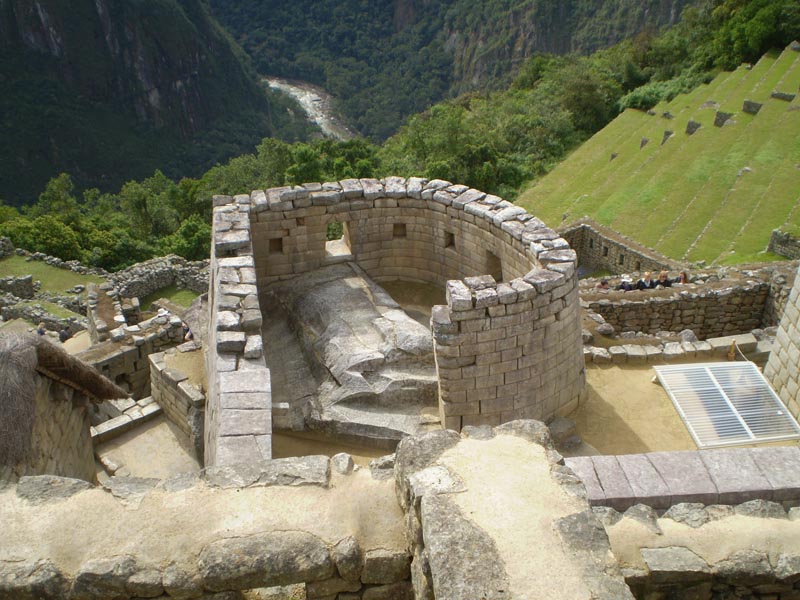
The architectural style of Machu Picchu is very similar to Ollantaytambo fortress. This was a holy city built to worship nature and the gods. It is sited strategically between 4 mountains that map out the Southern Cross constellation, near a mountain spring for water source, and with good astronomical orientation was a perfect site for the Incans. Machu Picchu also used tall and narrow storehouses that allowed cold night air to flow through the building, to cool the stored grains. Some architectural elements are designed to amplify sound for use in certain ceremonies. One could read more about Machu Picchu on wikipedia so I will just describe my experiences. Me and my friend walked to to the Sun Gate after our Machu Picchu Tour. The Sun Gate is the gap in mountains where the first ray of sunlight shines through and land on a stone slab in the Temple of the Sun on Summer Solstice. Eight llamas also live in Machu Picchu, like mascot animals, that they keep there.
Took train back to Cusco at night, flew out to Trujillo early next day.